You are running ads. Posting on social downlmedia. Sending emails. Maybe writing blogs or filming videos.
Yet the results still feel inconsistent.
For many businesses, the problem is not a lack of effort. It is a lack of structure.
That is where paid, owned and earned media can help.
These three types of media give you a simple way to understand where your marketing attention comes from, what you control, and how other people can help spread your message.
At the simplest level:
Paid media is exposure you pay for. Owned media is content and channels your business truly controls. Earned media is exposure other people give your brand through reviews, recommendations, shares, links and mentions.
The strongest marketing strategies do not treat these as three separate boxes. Instead, they connect them.
Paid media gets you seen. Owned media gives people somewhere useful to go. Earned media builds trust and extends your reach through other people.
In this guide, we will break down the difference between paid, owned and earned media, look at examples of each, and walk through seven practical ways to build a better marketing mix.
More importantly, we will show you how to make the whole system work together.
If you are new to the wider topic, start with our guide to what digital marketing is and how it works.
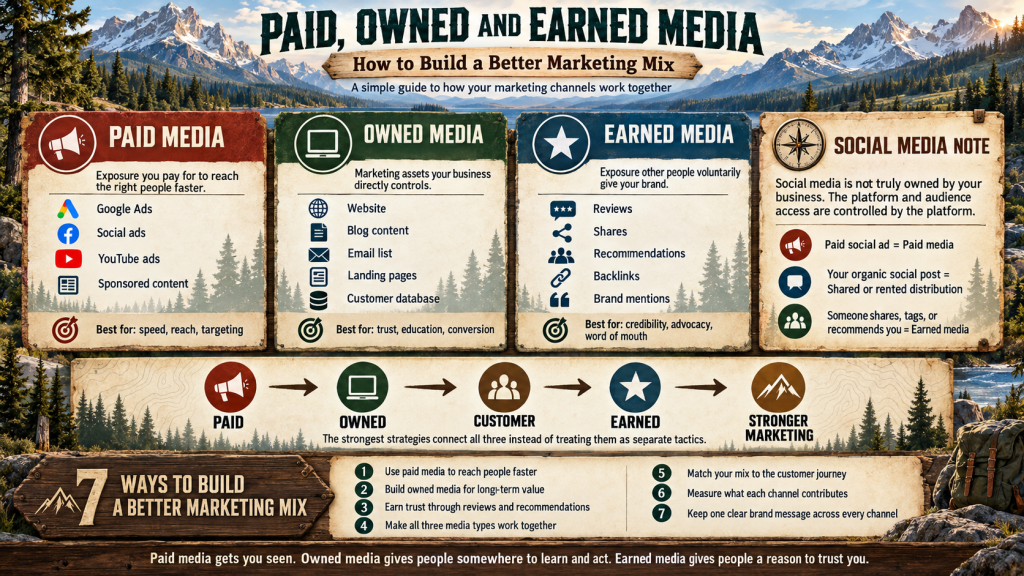
What Are Paid, Owned and Earned Media?
Paid, owned and earned media describe three different ways people can discover and interact with your business.
The terms are simple. However, understanding the differences can help you make much smarter decisions about where to put your time, budget and attention.
What Is Paid Media?
Paid media is marketing exposure your business pays to distribute.
In other words, you pay a platform, publisher, media company, creator or other third party to put your message in front of an audience.
Common paid media examples include:
- Google Ads
- Meta Ads
- LinkedIn Ads
- YouTube Ads
- Display advertising
- Sponsored articles
- Paid influencer partnerships
- Affiliate placements
- Newspaper advertising
- Radio advertising
- Television advertising
- Paid sponsorships
The biggest advantages of paid media are speed, targeting and control.
For example, imagine you sell premium mattresses.
You could place an ad in a local newspaper. Thousands of people might see it, but only a small percentage of those readers may actually need a mattress.
With digital advertising, you can take a much more targeted approach.
A Google Search campaign can put your business in front of someone who is actively searching for a mattress right now.
That person already has a problem. They are already looking for a solution.
As a result, paid media gives you the ability to reach the right person at a useful moment.
Harvard Business School Online describes paid media as marketing efforts where a business pays to display promotional content through channels such as search engines, websites and social platforms.
If paid advertising is part of your strategy, it should also connect to a wider digital marketing plan rather than operating on its own.
Key takeaway: Paid media helps you buy attention quickly, but that attention often slows down or disappears when the spending stops.
What Is Owned Media?
Owned media is content, channels and marketing assets your business directly controls.
Your website is one of the clearest examples.
Other owned media can include:
- Website pages
- Blog articles
- Landing pages
- Email lists
- Email newsletters
- Videos and original media files
- Podcasts
- Downloadable guides
- Checklists
- Case studies
- Product guides
- Webinars
- Customer databases
Owned media is your marketing home base.
Instead of paying for every visit, click or impression, you are building something that can continue creating value over time.
For example, a useful article might attract search traffic long after it is published.
Likewise, a well-built email list gives you a direct way to reach people who have chosen to hear from you.
A strong website can educate customers, build trust, answer questions and generate leads every day.
Is Social Media Really Owned Media?
This is where the traditional paid, owned and earned framework needs some nuance.
Some marketing frameworks classify a post published by your company on Facebook, LinkedIn, Instagram or another social platform as owned media because your business creates and controls the content of the post.
However, your business does not own the platform.
You do not control the algorithm.
You do not control how many followers see your content.
You do not own your followers in the same way you control an email list or customer database.
You also cannot guarantee that the platform, account, feature or distribution model will remain the same.
For that reason, it is more useful to think of organic social media as shared or rented media.
You control what you publish, but you are distributing it on someone else's property.
This is different from a website you control, an email database you can export, or original content files your business owns.
Therefore, throughout this guide, we treat websites, email lists, customer databases and original content libraries as true owned assets.
Social media can still play an important role in distributing that content. However, it should not replace the marketing assets your business actually controls.
Your website should sit at the centre of that system. If yours is not pulling its weight, our guide to website design and development explains what a business website should actually do.
Key takeaway: Owned media gives paid, social and earned attention somewhere useful to go, while building assets your business can control over the long term.
What Is Earned Media?
Earned media is exposure other people voluntarily give your business.
Instead of your company publishing the message, someone else is talking about you or helping distribute your message.
Examples include:
- Customer reviews
- Word-of-mouth recommendations
- Organic social shares
- Social media mentions
- Backlinks from other websites
- Media coverage
- Unpaid influencer mentions
- Forum discussions
- Community recommendations
- User-generated content
- Customers tagging your business
- People recommending your company in online groups
Earned media is different because you cannot control it in the same way as advertising or your own website.
You can encourage reviews.
You can create useful content.
You can build relationships with customers and your community.
Ultimately, though, the other person decides what they say, whether they share your content, and whether they recommend your business.
That lack of control can also make earned media valuable.
A business telling you it is great is advertising.
A customer telling you the business is great is a recommendation.
The message comes from a different source.
This is also where much of the real power of social media appears.
Your company publishing a Facebook or LinkedIn post is distribution.
Someone else sharing that post, recommending your company, tagging a friend, discussing your brand or creating their own content about you is earned media.
Therefore, the best way to earn positive media is not through a trick. It is to give people something worth talking about.
That means:
- Delivering a good experience
- Solving real problems
- Communicating clearly
- Creating useful resources
- Following through
- Helping customers
- Building strong relationships
Key takeaway: Earned media may be harder to control, but it can build credibility and reach because other people choose to carry your message forward.
Paid vs. Owned vs. Earned Media: What Is the Difference?
All three media types can help people discover your business.
However, the main differences come down to who creates the message, who controls distribution, where the investment happens and what role the media plays in the customer journey.
Paid, Owned and Earned Media Comparison
| Factor | Paid Media | Owned Media | Earned Media |
|---|---|---|---|
| Main purpose | Reach | Build and convert | Trust and advocacy |
| Who creates it? | Usually the brand | Brand | Customers or third parties |
| Who controls distribution? | Brand and platform | Mostly the brand | Third party |
| Direct media cost | Usually yes | Usually no placement cost | Usually no placement cost |
| Speed | Fast | Often slower | Unpredictable |
| Targeting | High | Audience-dependent | Low |
| Trust | Moderate | Moderate to high | Often high |
| Longevity | Usually tied to spend | Can compound over time | Varies |
| Simple example | Google Ad | Website article | Customer review |
Social media sits across this framework rather than fitting perfectly into one box.
A paid social advertisement is paid media.
Content your company publishes organically is brand-controlled content distributed on a third-party platform.
A customer sharing, mentioning or recommending your company is earned media.
That distinction matters because publishing content somewhere does not mean you own the channel or audience.
The Biggest Difference Is Control
Think about the three types of media on a spectrum.
Owned media generally gives you the most control.
You decide what goes on your website, what your email says, how your landing page works and what content you create.
More importantly, you retain control of the asset.
Paid media gives you strong control, but within the rules of the platform.
You may choose the audience, message, budget and campaign goal. However, Google, Meta, LinkedIn and other platforms still decide how their advertising systems operate.
Earned media gives you the least control.
Customers, journalists, creators and other businesses decide whether they mention you and what they say.
Still, more control does not automatically mean better marketing.
Earned media can be powerful precisely because your company did not write the message.
So the goal is not to choose the media type with the most control. Instead, it is to understand what each type does best.
None of the Three Is Really Free
It is tempting to describe owned and earned media as "free marketing."
That can be misleading.
Paid media has an obvious cost because you are buying advertising.
Owned media still requires resources such as:
- Staff time
- Writing
- Photography
- Video production
- Graphic design
- Website development
- SEO
- Software
- Email platforms
- Strategy
Earned media also requires investment.
For example, good reviews usually come from good customer experiences.
Media coverage may require public relations work.
Backlinks can come from creating useful resources.
Word of mouth grows when a business consistently delivers value.
Therefore, the real difference is not simply whether marketing costs money.
It is where you make the investment and what you build from it.
Now that the differences are clear, the bigger question is how to use all three together.
1. Use Paid Media to Reach the Right People Faster
Paid media is valuable when you need visibility now.
It can help a new business enter a market, promote an important service, capture existing demand or put an offer in front of people who are likely to need it.
However, the goal is not simply to buy more traffic.
The goal is to buy the right attention.
Start With Audience Intent
Not every website visitor is equally valuable.
A person casually watching a video may be at a very different stage than someone searching:
"emergency plumber near me"
or:
"replacement skid steer tracks"
The second type of search shows clear intent.
The person has a problem and is actively looking for an answer.
Depending on your business, paid media can help you reach people who are:
- Searching for a solution
- Comparing different providers
- Interested in a relevant topic
- Located in your service area
- Visiting important pages on your website
- Likely to need your product or service
Search advertising is especially useful for capturing demand that already exists.
Meanwhile, other platforms can help create awareness before someone starts searching.
Match the Channel to the Goal
Different paid channels solve different problems.
For example:
Google Search Ads: Useful for reaching people who are already searching for a product, service or solution.
Meta Ads: Useful for building awareness, promoting content, reaching defined audiences and retargeting previous visitors.
LinkedIn Ads: Useful when the audience is defined by professional role, company or industry.
YouTube Ads: Useful when video can introduce a problem, educate the customer or build awareness.
You do not need to advertise everywhere.
Instead, choose the channel that gives you the best opportunity to reach the right person at the right point in their journey.
Do Not Use Paid Media to Fix Weak Marketing
Advertising amplifies what is already there.
That can be good or bad.
More traffic will not automatically fix:
- Weak messaging
- A confusing website
- Poor landing pages
- An unclear offer
- Slow response times
- A frustrating customer experience
For instance, if 100 visitors cannot understand what you sell, sending another 1,000 visitors to the page may simply create more confusion.
Fix the trail before sending more hikers down it.
Takeaway: Paid media works best when you know who you want to reach, what you want them to do and where you are sending them next.
2. Build Owned Media That Creates Long-Term Value
Paid campaigns can create a burst of attention.
Owned media gives you something to build on.
It is where customers learn about your business, understand your offer and decide whether you can help them.
Treat Your Website as Your Marketing Home Base
Your website should do more than look professional.
It should help visitors quickly understand:
- What you offer
- Who you help
- What problem you solve
- Why your solution matters
- Why they should trust you
- What they should do next
A visitor should not have to dig through five pages to figure out what your company actually does.
Clarity matters.
At the same time, a strong website can connect the rest of your marketing together.
An ad can send someone to a landing page.
A social post can lead to an article.
An article can lead to an email signup.
An email can lead to a case study.
A case study can lead to an enquiry.
As a result, the website becomes the central camp where all the trails connect.
You can learn more about this approach in our guide to building websites that support real business goals.
Create Content That Answers Real Customer Questions
One of the best ways to build owned media is to answer the questions customers already ask.
This can include:
- Blog articles
- Videos
- FAQs
- Guides
- Tutorials
- Checklists
- Comparisons
- Case studies
- Product resources
- Calculators
- Downloadable worksheets
Good content is useful before it is promotional.
For example, if a customer is wondering how to measure a rubber track, how much a service costs, what option is right for them or what to expect before hiring someone, that question can become content.
Search engine optimization can then help those answers appear when people search for them.
Over time, content creation can become a long-term discovery system instead of simply another weekly posting task.
You can then use social platforms to distribute that owned content and make it easier for other people to discover, discuss and share it.
Build an Audience You Can Reach Again
There is also an important difference between renting attention and building an audience you can reach directly.
Advertising rents attention.
Social media also gives you access to an audience inside someone else's platform.
Even if your business has 10,000 followers, the platform still controls how and when you can reach those people.
By comparison, an email list or customer database gives you a much more direct relationship with people who have chosen to hear from your business.
That does not mean email is free, nor does it mean every subscriber will become a customer.
Instead, it means you are building an asset that is far less dependent on another company's algorithm.
Takeaway: Owned media should not be treated as leftover content. It is an asset your marketing can continue building on.
3. Earn Trust Through Reviews, Shares and Recommendations
You cannot force people to recommend your company.
However, you can create the conditions that make recommendations more likely.
That makes earned media partly a marketing issue and partly a customer experience issue.
Great Earned Media Starts With a Great Experience
The best review strategy begins before anyone writes a review.
It starts with the experience you deliver.
That means:
- Doing what you said you would do
- Communicating clearly
- Solving the customer's problem
- Responding when something goes wrong
- Making the process easy
- Delivering value worth remembering
A clever review campaign cannot permanently hide a poor customer experience.
In many cases, earned media is the market reflecting your reputation back to you.
Make Reviews Part of the Customer Journey
Many satisfied customers are willing to leave a review.
They simply never think about it.
A simple process can help.
You might:
- Identify a natural point after successful work is completed.
- Ask the customer for an honest review.
- Give them a direct link.
- Make the process easy.
- Respond professionally to reviews when appropriate.
The goal is not to pressure customers into saying something positive.
Instead, make it easier for genuine customers to share their experience.
Create Content People Want to Share
Owned media can also create earned media.
For example, a useful guide might get linked to from another website.
A strong video may be shared.
An original industry resource might be mentioned in a newsletter.
A practical checklist could be passed between coworkers.
Likewise, a useful article shared through LinkedIn or Facebook can gain earned reach when other people choose to share it with their own networks.
Shareable content is often:
- Useful
- Original
- Practical
- Timely
- Easy to understand
- Relevant to a real problem
- Interesting enough to get attention
This is where owned, social and earned media begin to work together.
Takeaway: You cannot order earned media like an ad placement. You earn it by creating experiences, relationships and content worth talking about.
4. Make Paid, Owned and Earned Media Work Together
This is where the framework becomes much more useful.
Paid, owned and earned media should not operate as three isolated departments.
Instead, they should strengthen one another.
Think of Your Media as a System
A simple customer journey might look like this:
Paid → Owned → Customer → Earned
A person discovers you through a paid search ad.
Then they land on an owned page on your website.
The page answers their questions and helps them become a customer.
Next, they have a good experience.
Later, they leave a review or recommend your company.
That earned media helps the next customer trust you.
Now the system becomes:
Paid → Owned → Customer → Earned → Stronger Paid + Owned
That is much more powerful than asking:
"Should we do Google Ads or social media?"
A better question is:
How does this channel support the rest of our marketing system?
That systems-based approach is central to how we think about digital marketing strategy at Eagle Vision Agency.
Earned Media Can Strengthen Paid Media
Reviews and customer stories do not need to sit in isolation.
Where appropriate, genuine social proof can strengthen:
- Landing pages
- Advertisements
- Email campaigns
- Website pages
- Sales presentations
- Proposals
- Product pages
A paid campaign may introduce your business.
Then a customer story may help someone believe your claims.
Finally, an owned landing page gives them somewhere to act.
Each part does a different job.
One Piece of Content Can Move Through Several Types of Media
Imagine your company publishes a useful guide on its own website.
That guide is owned media.
Next, you share the guide on LinkedIn.
You created the social post, but LinkedIn controls the platform and access to the audience. It is better thought of as shared or rented distribution than a true owned asset.
Then you pay to promote that post.
The paid distribution is paid media.
Finally, another person reads the guide, recommends it to their network and shares the link.
That exposure becomes earned media.
One piece of content can therefore move across several types of media.
This is why the boundaries can sometimes look blurry.
The important questions are:
Who owns the asset?
Who controls the distribution?
Who chose to spread the message?
Takeaway: Stop thinking about paid, owned and earned media as separate buckets. Instead, look for ways each one can make the others stronger.
5. Match Your Media Mix to the Customer Journey
Not every customer needs the same message.
Someone discovering your business for the first time has different questions than someone comparing quotes or getting ready to buy.
Therefore, a better media mix considers where the customer is in that journey.
Awareness Stage
At the awareness stage, someone may not know your company exists.
They may not even fully understand their problem yet.
Useful channels can include:
- Paid social advertising
- Video advertising
- Display advertising
- Educational articles
- Social media distribution
- Public relations
- Earned shares
- Helpful videos
The goal is simple:
Become visible and relevant.
Do not expect every person seeing your first piece of content to buy immediately.
Some people need to understand the problem before they are ready for the solution.
Consideration Stage
Next, the customer realizes they need something.
They may be comparing providers, researching solutions or trying to understand their options.
Useful media can include:
- Website service pages
- Blog content
- Case studies
- FAQs
- Product guides
- Reviews
- Testimonials
- Comparison content
At this stage, the goal becomes:
Build understanding and trust.
Your owned and earned media can be especially valuable here.
The website explains your solution.
Reviews provide outside reassurance.
Case studies show what working with you can look like.
Decision Stage
Now the customer is close to acting.
At this point, clarity matters even more.
Useful tools can include:
- Search advertising
- Focused landing pages
- Reviews
- Testimonials
- Clear offers
- Retargeting
- Strong calls to action
- Easy contact options
The goal is:
Make the next step easy.
Do not make an interested buyer search your website for a phone number, form or next step.
Retention and Advocacy Stage
Finally, the marketing journey does not need to stop at the sale.
Existing customers can become repeat customers, subscribers, referrers and advocates.
Useful channels include:
- Helpful customer content
- Follow-up
- Customer service
- Referral programs
- Review requests
- Educational resources
- Social communities
The goal is to continue delivering value.
As a result, a successful customer can become the source of future earned media.
Takeaway: Your media mix should follow the customer journey. Different channels become more valuable at different stages.
6. Measure What Each Media Type Is Actually Doing
A common marketing mistake is measuring every channel with the same scorecard.
Different media types do different jobs.
Therefore, they should not always be judged by the same metric.
Paid Media Metrics
Depending on the campaign, useful paid media measurements can include:
- Impressions
- Click-through rate
- Cost per click
- Cost per lead
- Conversion rate
- Cost per acquisition
- Return on ad spend
However, do not stop at the advertising dashboard.
A cheap click that never turns into a customer is still just a click.
Owned Media Metrics
Useful owned media measurements can include:
- Organic website traffic
- Search rankings
- Email subscribers
- Leads
- Conversion rate
- Returning visitors
- Resource downloads
- Contact form submissions
- Email engagement
You may also need to look at how owned media assists other channels.
For example, an article might introduce a visitor who returns later through search or direct traffic.
Likewise, an email may keep your company top of mind until the customer is ready to act.
Earned Media Metrics
Earned media can be less predictable, but it can still be measured.
Possible indicators include:
- Number of reviews
- Average review rating
- Brand mentions
- Organic social shares
- Referral traffic
- Backlinks
- Media coverage
- Recommendations
- User-generated content
Social media becomes especially useful here because it makes many forms of word of mouth visible.
People can share your content, tag your company, recommend you in comments, mention you in groups or create their own content around your brand.
Those actions are different from the content your company publishes itself.
Connect Marketing Metrics to Business Results
Followers can be useful.
Views can be useful.
Traffic can be useful.
However, none of those automatically mean the business is growing.
Whenever possible, connect marketing activity to:
Lead → Opportunity → Customer → Revenue
For a service business, that might mean tracking:
- Calls
- Forms
- Qualified leads
- Booked appointments
- Estimates
- Sales
For an ecommerce business, it might include:
- Product views
- Add-to-cart activity
- Checkout activity
- Purchases
- Repeat purchases
Ultimately, this gives you a much clearer picture of whether your marketing mix is helping the business.
Takeaway: Measure each media type according to the job it is supposed to do, then connect those measurements back to real business outcomes.
7. Keep One Clear Brand Message Across Every Channel
You can have good advertising, a strong website, active social channels and excellent reviews.
But if every channel tells a different story, your marketing will still feel scattered.
Tools create motion.
Branding gives that motion direction.
Tools Create Motion. Branding Gives Direction.
Marketing technology gives businesses more ways to communicate than ever.
However, tools are not strategy.
Before you add another platform, campaign or content format, ask:
- Who are we trying to reach?
- What problem are they trying to solve?
- What do we want them to understand?
- Why should they care?
- What should they do next?
Those answers should remain recognizable whether someone finds you through an ad, website, video, email, social platform or recommendation.
If your marketing sounds different everywhere, start with our guide to the 22 essential elements of brand messaging.
Lead With Value Before Asking for the Sale
Gary Vaynerchuk's Jab, Jab, Jab, Right Hook offers a useful way to think about marketing communication.
The "jabs" are the value you give.
That might include:
- Tips
- Education
- Answers
- Tools
- Entertainment
- Useful resources
The "right hook" is the ask.
That could be:
- Buy now
- Request a quote
- Book a call
- Download the guide
- Sign up
- Contact us
The lesson is not that every company needs an exact number of value posts before making an offer.
Instead, the useful principle is much simpler:
Do not make every interaction an immediate sales pitch.
Help people before constantly asking them to buy.
Give People a Reason to Care
Bernadette Jiwa's Fortune Cookie Principle gives us another useful lens.
Think about your product or service as having two parts.
The cookie is what you sell.
The fortune is what it means to the customer.
A mattress is foam, fabric and springs.
However, to a shift worker, a better mattress may represent better sleep, more energy and feeling human again after a long night.
That meaning gives marketing more emotional weight.
The same idea works for almost any business.
Customers usually care less about your list of features than they care about what those features help them do, solve, avoid or become.
This is closely connected to building a strong value proposition.
Make the Customer the Hero
The StoryBrand framework offers another simple principle.
Your customer is the hero.
Your company is the guide.
Your message should make it easy to understand:
- The customer's problem
- How you help
- The plan
- The next step
- The desired result
This shift matters because many businesses spend too much time talking about themselves.
Years in business.
Equipment.
Awards.
Credentials.
History.
Those things can support trust. However, the customer's first question is often much simpler:
Can you help me solve my problem?
Consistency Makes the Media Mix Stronger
Your:
- Ads
- Website
- Emails
- Videos
- Social posts
- Sales conversations
should reinforce the same core message.
The words do not need to be identical everywhere.
The idea should be.
That is one of the reasons we use the Brand Compass at Eagle Vision Agency.
The Brand Compass framework helps businesses clarify who they serve, why they matter, what makes them different and what they need to say across their website, advertising, sales and content.
Takeaway: A media mix is only as strong as the message travelling through it. Clarity makes every channel easier to understand and more useful.
Paid, Owned and Earned Media Example: Dyne Industries
A practical example makes the framework easier to see.
Dyne Industries sells replacement rubber tracks for heavy equipment.
Here is how the three types of media can work together.
Paid Media
A contractor needs new rubber tracks for a skid steer.
They search Google for something like:
"skid steer rubber tracks"
A paid search campaign can help put Dyne in front of that buyer while they are actively looking.
That is paid media capturing existing demand.
Owned Media
Next, the visitor clicks through to Dyne's website.
The website can help them:
- Understand the available product options
- Find the right type of track
- Learn how tracks are measured
- Get answers to common questions
- Read educational resources
- Request information
- Make a purchase
Those pages, guides and resources are owned media.
The advertising created the visit.
The owned media helps turn that attention into action.
Earned Media
After a successful experience, a customer may:
- Leave a review
- Recommend Dyne to another equipment owner
- Share a useful guide
- Mention the company in an industry discussion
- Refer another buyer
Those actions can create earned media.
If Dyne shares its own article on Facebook, that is content being distributed through a third-party social platform.
If an equipment owner then shares the article with another contractor or recommends Dyne in a Facebook group, that additional exposure is earned.
The Full Marketing Cycle
The journey can look like this:
Google Search → Paid Ad → Website → Customer → Review or Recommendation → Greater Trust → More Customers
No single piece is doing everything.
Instead, each part supports the next.
That is what a connected media mix is supposed to do.
How to Create Your Own Paid, Owned and Earned Media Mix
You do not need a complicated media plan to begin.
Start by looking at what your business is already doing.
Then find the biggest gaps.
Step 1: List Your Current Paid Media
Ask:
Where are we currently paying for attention?
Your list might include:
- Google Ads
- Meta Ads
- LinkedIn Ads
- Sponsorships
- Influencer partnerships
- Print advertising
- Radio
- Trade publications
- Display ads
Do not judge the channels yet.
First, simply map what exists.
Step 2: List Your Owned Media
Next ask:
What useful marketing assets do we actually control?
Examples include:
- Website
- Service pages
- Blog
- Original videos
- Email list
- Newsletter
- Guides
- Worksheets
- Case studies
- Podcast
- Customer database
- Original photography and media libraries
Pay attention to quality as well as quantity.
For example, ten weak blog posts are not automatically more valuable than one excellent resource answering an important customer question.
Also, separate true owned assets from platforms where you simply have an account.
Your Facebook followers may be valuable, but you do not own Facebook or control access to that audience.
Step 3: List Your Earned Media
Now ask:
Where are other people already talking about us?
Look for:
- Reviews
- Referrals
- Social shares
- Social mentions
- Media coverage
- Backlinks
- Brand mentions
- Community recommendations
- User-generated content
You may discover that your business has more earned media than you realized.
On the other hand, you may discover that happy customers are not being given an easy opportunity to share their experience.
Step 4: Find the Gaps
Now look across the three lists.
Patterns will usually appear.
For example:
Lots of paid traffic but a weak website: Strengthen owned media.
Great website but very little traffic: Improve distribution through SEO, advertising, social media, partnerships or other channels.
Happy customers but few reviews: Build a simple review process.
Large social following but no email list: Start moving interested followers toward an audience you can reach more directly.
Strong content but few shares: Revisit distribution and whether the content gives people a reason to pass it along.
Step 5: Pick the Next Priority
Do not try to rebuild everything at once.
Instead, find the biggest bottleneck.
Then improve that piece.
Your best next move might be:
- Fixing the website
- Building a landing page
- Starting search advertising
- Creating one excellent guide
- Improving your review process
- Starting an email list
- Clarifying your brand message
Once that weakness improves, look at the system again.
If you want to build your marketing knowledge step by step, our free digital marketing course includes practical lessons, guides and worksheets designed for business owners and marketing teams.
Takeaway: A useful media strategy starts with knowing what you already have and finding the weakest link between attention, trust and conversion.
Common Paid, Owned and Earned Media Mistakes
Understanding the framework is one thing.
Using it well requires avoiding a few common traps.
Relying Too Heavily on Paid Advertising
Advertising can generate leads quickly.
However, if paid media is your only reliable source of attention, your marketing can become very dependent on advertising spend.
When the budget stops, traffic may drop with it.
Better approach: Use some of the attention you buy to strengthen owned assets such as your website, content, customer list and email audience.
Mistaking Social Followers for an Audience You Own
A large social following can be valuable.
However, it is not the same as owning the relationship.
The platform controls the environment.
Algorithms change.
Organic reach changes.
Accounts can be restricted.
Features disappear.
New platforms replace old ones.
Most importantly, having a follower does not necessarily give you a direct way to contact that person outside the platform.
Better approach: Use social media to distribute useful content, create conversation and earn attention. At the same time, give interested people a reason to visit your website, join your email list or enter a customer relationship you can manage directly.
Expecting Earned Media Without Earning It
Reviews, recommendations and referrals are not simply promotional tactics.
They are often the result of the experience you create.
Better approach: Deliver well, make feedback easy and give customers something worth recommending.
Treating Every Channel as a Separate Campaign
Disconnected marketing creates extra work.
The ad team makes one message.
The social team makes another.
The website says something different.
Sales staff explain the offer another way.
As a result, the customer gets confused.
Better approach: Build campaigns around one clear customer problem and message, then adapt that message for each channel.
Sending More Traffic to an Unclear Message
This is one of the most expensive mistakes a business can make.
If the message is confusing, more traffic may simply create more confused visitors.
Before increasing your advertising budget, make sure people can quickly understand:
- What you offer
- Who it is for
- Why it matters
- What they should do next
Takeaway: Do not mistake more activity for a stronger system. Fix the weak connection before adding more traffic.
Which Is Better: Paid, Owned or Earned Media?
None is automatically better.
They perform different jobs.
So instead of asking:
Which media type should we choose?
Ask:
What job does our marketing need to do right now?
Use Paid Media When You Need Speed
Paid media can be useful for:
- Product launches
- Promotions
- Lead generation
- Capturing search demand
- Reaching a defined audience
- Testing messages and offers
It lets you put a message in the market quickly.
Build Owned Media for Long-Term Growth
Owned media is valuable for:
- SEO
- Customer education
- Lead nurturing
- Conversion
- Email marketing
- Customer retention
- Building authority
It gives your business useful assets that can continue working over time.
Build Earned Media for Trust and Advocacy
Earned media helps with:
- Reputation
- Credibility
- Referrals
- Word of mouth
- Social proof
- Organic social sharing
- Broader awareness
It allows other people to add their voice to your marketing.
The Best Strategy Uses a Balanced Media Mix
"Balanced" does not mean putting exactly one-third of your budget into each media type.
A local contractor and a national ecommerce business may need very different mixes.
Your priorities depend on:
- Goals
- Audience
- Budget
- Timeline
- Customer journey
- Existing marketing assets
- Competitive environment
Ultimately, the right balance is the one that helps the whole system work.
Map Your Paid, Owned and Earned Media
Understanding paid, owned and earned media is useful.
Mapping the framework onto your own business is where it becomes actionable.
Start with three questions.
Ask Yourself These Three Questions
Paid: Where are we paying for attention?
Owned: What marketing assets do we truly control?
Earned: Where are other people recommending, sharing or talking about us?
Then go deeper:
- Which area is strongest?
- Which area is weakest?
- Where are customers getting stuck?
- Are we too dependent on one channel?
- Are we building assets we actually control?
- Do our channels connect?
- Does the message stay consistent?
- What should we improve next?
Download the Map Your Media Mix Worksheet
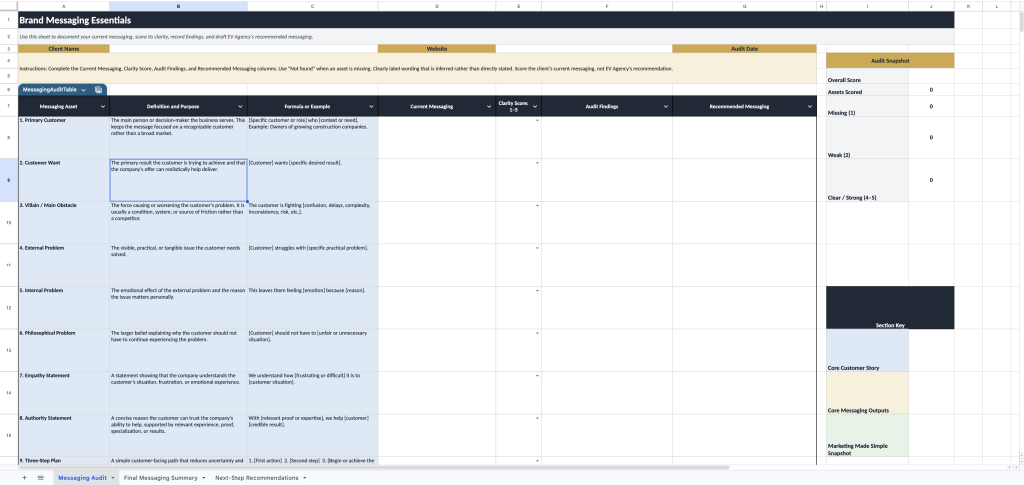
We created the Map Your Media Mix Worksheet to help you put this framework into practice.
Use it to:
- Inventory your current marketing channels
- Organize your paid, owned and earned media
- Separate true owned assets from rented platforms
- Spot gaps in your marketing system
- Identify weak points
- Decide what to improve next
- Build a clearer media mix around your goals
Download the free Map Your Media Mix Worksheet and start mapping your marketing system.
Then, if your channels are active but the message running through them still feels unclear, work through the Brand Compass and its 22 essential brand messaging elements.
Clear marketing starts with knowing where you are, where you are going and what path connects the two.
Build a Paid, Owned and Earned Media System That Works Together
The biggest lesson from the paid, owned and earned media framework is not that your marketing belongs in three neat boxes.
It is that different types of media can strengthen one another.
A strong marketing mix does seven things:
- Uses paid media to reach the right people faster.
- Builds owned media that creates long-term value.
- Earns trust through reviews, recommendations and shares.
- Connects paid, owned and earned media into one system.
- Matches different media to different stages of the customer journey.
- Measures what each channel actually contributes.
- Keeps one clear brand message across the entire system.
Remember the simple framework:
Paid media gets you seen.
Owned media gives people somewhere you control to learn and act.
Earned media gets other people talking, sharing and building trust around your brand.
Social media can help connect all three, but it is important not to confuse access with ownership.
You can build a large following on a social platform without truly owning the audience.
That is why the strongest marketing systems use platforms such as Facebook, Instagram, LinkedIn and YouTube for distribution, conversation and earned reach while continuing to build websites, email lists, customer relationships and content assets they can control.
When all of these pieces work together around a clear message, you have more than a collection of marketing tactics.
You have a marketing system.
At Eagle Vision Agency, we outfit ambitious brands who feel lost in the marketing wilderness with clarity, bold visuals and a map so they can attract the right customers and grow with confidence.
Your next step does not need to be complicated.
Download the Map Your Media Mix Worksheet and map out where your business stands today.
Then, if your marketing channels are moving but your message still lacks direction, use the Brand Compass to strengthen the message connecting everything together.
And if you need help turning those pieces into a practical marketing system, contact Eagle Vision Agency and we will help you map the next step.
Frequently Asked Questions About Paid, Owned and Earned Media
What is the difference between paid, owned and earned media?
Paid media is exposure your business pays for, such as Google Ads. Owned media is content and marketing assets your business creates and controls, such as your website or email list. Earned media is voluntary exposure from customers or third parties, such as reviews, recommendations and organic shares.
What are examples of paid, owned and earned media?
A simple example is:
Paid: A Google Ad.
Owned: An article on your company website.
Earned: A customer review.
Other examples include paid social advertising, email newsletters, videos, social shares, backlinks, referrals and media coverage.
What falls under paid media?
Paid media includes advertising or exposure a company pays to distribute. Examples include PPC advertising, paid search, social media ads, display advertising, sponsored content, paid influencer partnerships, affiliate placements, print advertising, radio and television.
What are the disadvantages of paid media?
Paid media requires ongoing spending and can become more expensive as competition increases. Campaigns can also experience ad fatigue, depend heavily on platform rules, and lose traffic when the budget stops. In addition, paid traffic cannot fix weak messaging, poor landing pages or a bad customer experience.
What qualifies as earned media?
Earned media is voluntary exposure created by customers, publishers, communities or other third parties rather than purchased as advertising. Examples include reviews, recommendations, organic shares, unpaid brand mentions, backlinks, media coverage and word of mouth.
Is SEO owned or earned media?
SEO often connects owned and earned media.
The content and pages you publish on your own website are owned media. However, search visibility can also be strengthened by earned signals such as backlinks, mentions and references from other websites.
Is social media paid, owned or earned media?
Social media can involve paid and earned media, but the platform itself is not truly owned by your business.
A paid social advertisement is paid media.
When a customer shares your content, recommends your company, tags your brand, writes about you or mentions you voluntarily, that exposure is earned media.
A post published by your own company is more complicated. Traditional paid, owned and earned models sometimes classify brand-created social posts as owned media because the business controls the content. However, you do not own the social platform, control its algorithm or own direct access to your followers.
brand-controlled content distributed through shared or rented media.
Your website, email list and customer database are stronger examples of true owned media because your business has much greater control over the asset and the audience relationship.
Is influencer marketing paid or earned media?
It depends on the relationship.
If a company pays or contracts an influencer to promote a product, it is paid media. If a creator recommends a company voluntarily without a paid arrangement, the mention can be considered earned media.
Which is most important: paid, owned or earned media?
There is no universal winner.
Paid media is useful for speed and reach. Owned media helps build long-term assets and convert attention. Earned media strengthens trust and reputation. Strong marketing systems find the right role for each.
What is the 3-3-3 rule in marketing?
The term "3-3-3 rule" is used for different marketing, sales and communication ideas depending on the source.
It is not another name for the paid, owned and earned media framework.
Therefore, if you see the term used in a marketing guide, check how that specific source defines it before applying it to your strategy.
Do you own your social media followers?
Not in the same way you control an email list or customer database.
Your followers exist inside a third-party platform, and that platform controls how you can reach them. Algorithm changes, account restrictions and platform changes can all affect that access.
For this reason, businesses should use social media to build relationships and distribution while also giving interested people a reason to visit their website, subscribe to email or become part of a customer database they can reach more directly.