Content marketing is the long trail, not the flashy shortcut.
It is how you earn attention instead of buying it. It is how you build trust before you ask for a sale. And when it’s done right, it keeps working while you sleep, like a well-marked route that keeps guiding the right people back to your camp.
This guide breaks content marketing down in plain language. You’ll learn what it is, why it works, how to build a strategy, how to publish consistently, how to distribute it without being annoying, and how to measure results without getting lost in vanity metrics.
Along the way, you’ll see simple frameworks we use at EV Agency to help service businesses and B2B teams turn this into a steady lead engine.
Now let’s dive into the basics and build a solid map.
TL;DR
- Content marketing works because it helps people first, builds trust over time, and turns that trust into leads and sales.
- Start with a simple strategy: pick one audience, list their real questions, and publish answers that match what they are searching for.
- Cover the full funnel: awareness content to attract, comparison content to nurture, proof content to convert, and support content to retain.
- Win with consistency and distribution: publish on a schedule you can sustain, then share through your website, email, and one strong social channel.
- Track what matters and improve: measure traffic, signups, and conversions, refresh old posts, and double down on what is already working.
What Is Content Marketing?
Before we build the plan, we need a clean definition. Otherwise, you’ll end up “making content” without knowing what game you’re playing.
Content marketing means planning, creating, and sharing helpful content that attracts the right people and builds a relationship over time.
Semrush defines content marketing as planning, creating, and sharing valuable content to attract and engage a specific audience, and to build relationships that eventually contribute to business results.
In other words, content marketing is not a one-off post. It is a repeatable system built around your audience’s questions.
The real goal, trust first, revenue later
The goal of content marketing is not “go viral.”
The real goal is to become the brand people trust when they are finally ready to act. Content marketing builds familiarity.
Familiarity lowers perceived risk. And lower risk leads to more calls, more quote requests, and more yes decisions.
Think of it like this: if someone is heading into the backcountry, they don’t pick a guide from a random billboard. They pick the guide who taught them how to pack, where the hazards are, and how to stay safe.
That is what this approach does for your business. It teaches first, then it earns the right to sell.
What content marketing is not (common misconceptions)
Content marketing is not:
- Posting random tips on Instagram whenever you feel like it
- Writing blogs that never get shared and never get updated
- Stuffing keywords into AI-written pages and hoping Google won’t notice
- Running ads to thin content with no clear next step
- “Brand awareness” with no plan to turn attention into action
Content marketing is a system. Without a system, you are just throwing pebbles into the wind.
Wrap-up: once you treat content marketing like an engine, you stop chasing luck and start building momentum.
What Is Meant by Content Marketing?
People ask this because the term gets used for everything. So let’s tighten it up.
The simplest way to explain it (helpful content that earns attention)
The simplest explanation is this:
Content marketing earns attention by being useful.
You publish content that helps someone solve a real problem. They find it through search, social, email, or referrals. Then they start to trust you because you have been helping them before you ever asked for anything.
The “value exchange” behind content marketing
Every piece of this work is a trade:
- You give clarity, answers, and useful tools.
- Your audience gives attention, trust, and time.
Over time, that trust turns into:
- Email subscribers
- Quote requests
- Booked calls
- Repeat customers
- Referrals
This is why content marketing compounds. One good article can bring leads for years.
Content marketing in one sentence for leaders and teams
If you need a one-liner your team can rally around:
Content marketing is how we build trust at scale by answering the questions our buyers are already searching for.
Wrap-up: it’s not “more content.” It’s the right answers, delivered consistently, with a clear path to the next step.
Why Content Marketing Works
If you’ve ever felt like modern buyers are harder to reach, you’re not imagining it. The path to purchase has changed.
How content builds trust in modern buying
Most buyers do homework before they talk to sales.
They search. They compare. They watch videos. They ask peers. They read reviews.
Content marketing meets people in that research phase. It shows up when they are curious, cautious, and looking for proof.
That is why it’s so powerful for high-consideration services. It reduces fear. It answers the “what if” questions. It shows your experience before you show your pitch.
The business outcomes content supports
Strong content supports outcomes like:
- More qualified traffic from search
- Higher conversion rates, because visitors trust you sooner
- Shorter sales cycles, because objections get handled early
- Better lead quality, because your content filters out the wrong fit
- Stronger retention, because customers keep learning from you
Now here’s the important part: these outcomes happen when your system is built like a system, not a pile of posts.
Benefits you can measure
You can measure results in real numbers, including:
- Organic traffic growth
- Search impressions and clicks
- Email subscriber growth
- Demo requests, calls booked, quote requests
- Assisted conversions, meaning content that influenced deals
You can also measure engagement, but you have to measure it the right way. For example, Google Analytics describes engagement time for web as reflecting active interaction with a page, and average engagement time as time your site was in focus across sessions divided by active users.
Wrap-up: content marketing works because it matches how people buy now, and it creates measurable business value when you track the right things.
Content Marketing Versus
This is where a lot of teams get tangled up. Let’s separate the tools from the system.
Content marketing vs content strategy
- Content strategy is the map: who you’re targeting, what you’ll say, what you’ll publish, and why.
- Content marketing is the hike: creating content, publishing it, promoting it, and turning it into results.
Strategy without marketing is a plan that never leaves the desk. Marketing without strategy is a hike in circles.
Content marketing vs SEO
SEO helps people find your content through search.
Content marketing is the broader system that includes SEO, plus email, social, partnerships, and conversion paths.
Google’s SEO Starter Guide frames SEO as helping search engines crawl, index, and understand your content, and helping users decide whether they should visit your site from search. That is exactly why SEO and content marketing work best together.
Content marketing vs social media marketing
Social media marketing is usually:
- posting, community, short-form content, and paid boosts
Content marketing includes social, but also includes:
- long-form posts, videos, newsletters, case studies, and web assets that keep working
Social is often rented land. Your website and email list are home base.
Content marketing vs inbound marketing
Inbound marketing is the umbrella: attract, convert, close, delight.
Content marketing is one of the main engines inside inbound, because it attracts and nurtures with help instead of interruption.
Wrap-up: once you know the difference, you stop arguing about labels and start building a full system that works together.
How Content Marketing Works Across the Funnel
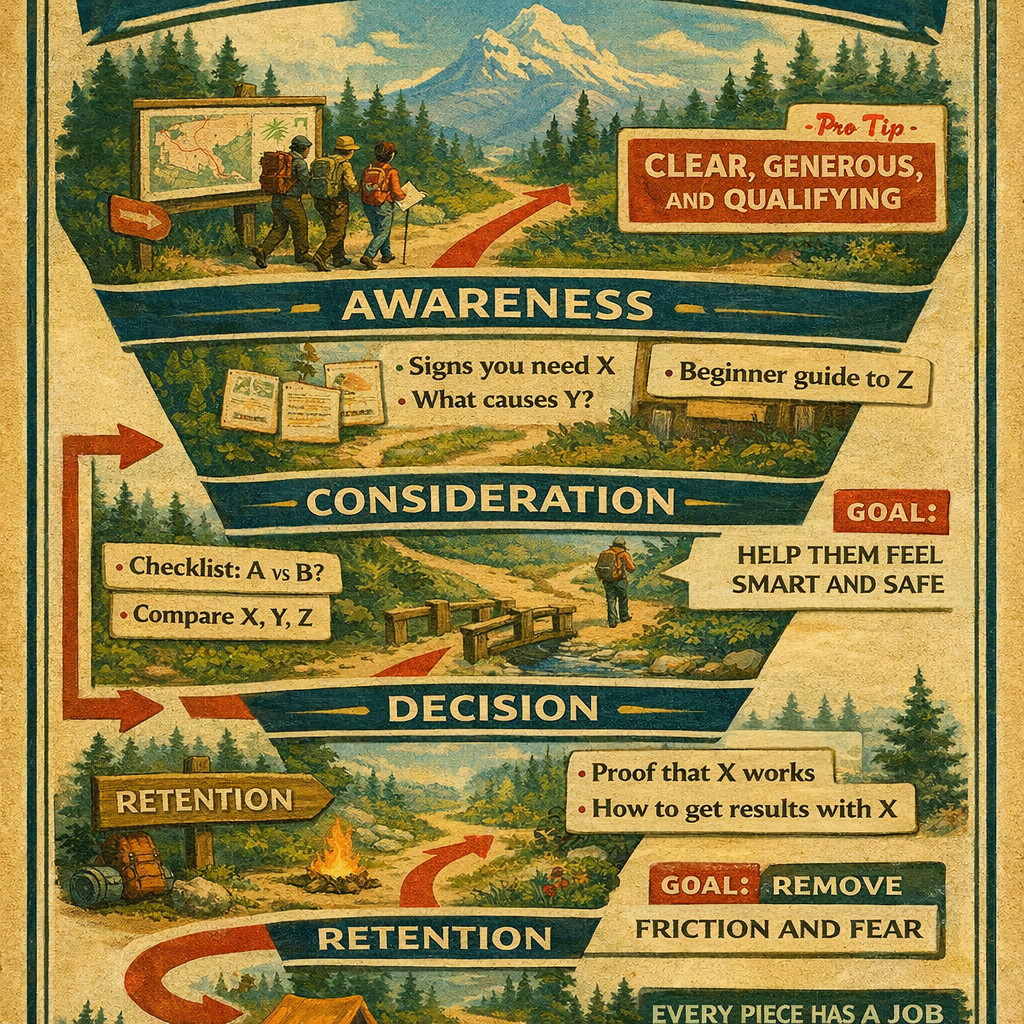
Content marketing works best when you stop thinking “what should we post” and start thinking “what does the buyer need next.”
Content marketing works best when you stop thinking “what should we post” and start thinking “what does the buyer need next.”
Awareness content, attract the right people
Awareness content is for people who:
- know they have a problem
- don’t know the best solution yet
Examples:
- “Signs you need X”
- “What causes Y?”
- “Beginner guide to Z”
Goal: get the right people onto your trail.
Pro tip: awareness content should be clear and generous, but it should also qualify. You want the right readers, not all readers.
Consideration content, help them compare
Consideration content is for people comparing options.
Examples:
- “X vs Y: which is better?”
- “What does X cost?”
- “How long does X take?”
- “Common mistakes and how to avoid them”
Goal: help them feel smart and safe choosing you.
Decision content, reduce risk and objections
Decision content is for people close to action.
Examples:
- case studies
- FAQs that address objections
- “what happens after you book”
- process pages and timelines
Goal: remove friction and fear.
Retention content, keep customers longer
Retention content keeps customers engaged and confident.
Examples:
- onboarding guides
- training videos
- maintenance tips
- updates and newsletters
Goal: keep them from wandering off to a competitor.
Wrap-up: funnel-based planning prevents wasted effort. Every piece has a job.
Content Marketing Formats and Content Types
Different formats fit different situations. Pick what you can actually sustain.
Blog content
Blogs are your long trail markers. A good post can rank for years if it stays updated.
Best for:
- SEO
- education
- evergreen traffic
- building authority
Video content
Video builds trust fast because people can see and hear you.
Best for:
- demos
- stories
- behind-the-scenes
- social and YouTube search
Email and newsletter content
Email is direct. No algorithm middleman.
Best for:
- nurturing leads
- retention
- promotions without spam
- weekly touchpoints
Social and short-form content
Short-form content is your trail signs near the road. It grabs attention and points people to deeper assets.
Best for:
- awareness
- community
- distribution
Lead magnets and long-form assets (ebooks, guides, webinars)
These trade deeper value for a lead.
Best for:
- B2B lead generation
- complex services
- high-consideration offers
Case studies and success stories
Case studies turn “trust me” into proof.
Best for:
- decision stage
- sales enablement
- reducing objections
Podcasts and audio content
Great for building a loyal audience over time.
Best for:
- thought leadership
- niche audiences
- relationship-building
Wrap-up: the best format is the one you will publish consistently, and the one your buyers actually use.
What Are the 4 Types of Content?
If you want a simple “content mix,” these four types cover almost everything.
Educational content (teach and explain)
This is your bread and butter. It answers questions and reduces confusion.
Examples:
- how-to posts
- checklists
- beginner guides
- troubleshooting
Entertaining content (hold attention and build affinity)
This keeps people around long enough to trust you.
Examples:
- short videos
- stories from the field
- light humor that fits your brand
Inspiring content (values, mission, identity)
This shows what you stand for and who you serve.
Examples:
- founder story
- customer mission stories
- community projects
Convincing content (proof, comparisons, objections)
This closes the loop and helps people choose.
Examples:
- case studies
- reviews
- comparisons
- ROI explanations
Wrap-up: most brands over-publish educational and under-publish convincing. Balance your mix.
Content Marketing Strategy
Now we build the map before we hike.
Set goals that match the business
Choose goals like:
- increase qualified leads
- reduce sales cycle time
- grow email list
- improve conversion rate from organic traffic
- increase retention and repeat purchases
Keep goals simple. If you measure everything, you focus on nothing.
A simple goal framework:
- One traffic goal
- One lead goal
- One sales-support goal
Define your audience, pains, and intent
Ask:
- Who are we trying to help?
- What pain do they feel?
- What are they searching for right now?
- What objections keep them stuck?
- What would “success” look like to them?
This is where content marketing starts. If you skip this, your message becomes generic fast.
Choose formats that fit your buyer journey
If your buyers need proof, prioritize:
- case studies
- comparison content
- FAQs
- “what to expect” pages
If your buyers need education, prioritize:
- blog pillars
- video explainers
- lead magnets
If your buyers need reassurance after purchase, prioritize:
- onboarding guides
- check-in emails
- maintenance content
Pick distribution channels that you can sustain
Pick fewer channels, run them well.
A simple starting stack:
- Website (blog)
- Email newsletter
- One social channel
Then add more once the engine is running.
Build a plan you can actually follow
A realistic plan beats an ambitious plan you abandon.
Start with:
- 2 high-quality posts per month
- 1 newsletter per week
- 2 to 3 short social posts per week that point back to your site
Wrap-up: strategy is about focus. Focus creates consistency. Consistency builds trust.
What Are the 7 Steps of Content Marketing?
If you want a clean process, follow these seven steps.
Step 1: Set goals and define success
Pick 1 to 3 goals and define the metric for each.
Example:
- “Increase organic leads by 30%”
- Track: form submissions from organic traffic
Step 2: Know your audience and their journey
Build a simple buyer journey:
- What do they search first?
- What do they compare next?
- What helps them decide?
- What makes them hesitate?
Step 3: Research topics and keywords
Use:
- Google autocomplete
- People Also Ask questions
- competitor blogs
- Search Console queries
- internal sales and support questions
Now here’s the trick: your best keyword list often lives inside your inbox and your call notes.
Step 4: Create content (with quality standards)
Quality standards matter more than volume.
At minimum:
- clear structure
- real examples
- accurate info
- scannable formatting
- a clear next step
Google recommends focusing on helpful, reliable, people-first content instead of content made mainly to manipulate rankings. That mindset is a content marketing advantage.
Step 5: Optimize for search and conversions
SEO is not magic. It’s clarity.
- match search intent
- use clean headings
- add internal links
- include a next step CTA
- make pages easy to scan on mobile
Step 6: Distribute and promote
If you publish and walk away, you waste the work.
Promote through:
- email
- social
- partnerships
- light paid boosting on winners
Step 7: Measure, learn, and improve
Review monthly:
- keep what works
- improve what is close
- cut what does nothing
- refresh content that is slipping
Wrap-up: content marketing is a loop, not a one-time project.
What Are the 5 C’s of Content Marketing?
This is a simple checklist to keep your content marketing grounded.
Customer (who you serve)
If you don’t know who it’s for, it won’t land.
Content (what you publish)
Pick a few core themes, not random topics.
Channel (where it lives)
Focus on channels you control first.
Consistency (how you build trust)
Consistency is the trust builder. It signals reliability.
Conversion (how it supports revenue)
Every piece needs a next step:
- subscribe
- download
- book a call
- request a quote
Wrap-up: most brands forget the last C. Conversion is where content marketing becomes a business engine.
Content Research, Keywords, and Topic Planning
This is where you find the right trailhead.
Topic selection that matches search intent
Ask: what does the searcher actually want?
- “What is content marketing?” wants a definition and examples
- “Content marketing strategy” wants a process and a template
- “Content marketing agency” wants help and proof
Match intent, and you win more often.
Keyword research for your topics
Start with:
- a core topic (your service or niche)
- related questions
- comparisons
- local intent (if you serve a region)
- problem-based keywords
Then pick:
- one primary keyword
- a handful of supporting phrases
- a list of related questions for your FAQ
Content gap analysis and competitive research
Look at competitors and ask:
- What are they ranking for that you are not?
- What questions are they skipping?
- Where are they vague?
- What examples are missing?
- What does the reader still not understand after reading?
Your job is not to copy. Your job is to build a better guide.
Pillar pages, clusters, and internal linking
A pillar page is the main hub guide.
Cluster posts support it and link back.
This builds topical authority, helps users explore deeper, and helps Google understand how your pages connect.
Turning one idea into a content series
One strong topic can become:
- 1 pillar post
- 5 supporting blog posts
- 10 social posts
- 1 email sequence
- 3 short videos
- 1 lead magnet
Wrap-up: topic planning keeps you from running in circles. It turns effort into a system.
Creating High-Quality Content That Ranks and Converts
High quality is not fancy writing. It’s useful writing.
What “high quality” means now
Google’s guidance encourages creators to publish helpful, people-first content that’s built for users, not loopholes.
In real terms, “high quality” means:
- it answers the question clearly
- it shows real experience
- it is easy to read
- it is accurate
- it is updated
- it helps the reader take a next step
That is content marketing in its best form.
Simple structure that makes content readable
Use a structure like:
- quick intro (what they’ll get)
- clear sections with descriptive headings
- examples and mini checklists
- short wrap-up and next step
Short paragraphs win. Big blocks lose.
A simple writing rule: if your paragraph has more than four lines on mobile, split it.
On-page SEO basics
Start here:
- strong title that matches intent
- one H1
- descriptive H2s and H3s
- internal links to related posts
- image alt text that describes the image
- meta description that earns the click
- fast load speed and clean mobile layout
Google’s SEO Starter Guide is still a solid baseline for these fundamentals.
Conversion basics, CTAs, offers, and next steps
Every post should have a simple next step like:
- “Get a quote”
- “Book a discovery call”
- “Download the checklist”
- “Join the newsletter”
If the reader finishes your post and has nowhere to go, you just lost momentum.
A practical CTA ladder:
- awareness post: subscribe or read next
- consideration post: download checklist or pricing guide
- decision post: book call or request quote
- retention post: training resource or upgrade path
Content refresh, updates, and keeping posts alive
Don’t just publish and forget.
Refresh top posts every 6 to 12 months:
- update stats
- improve examples
- add FAQs
- tighten the intro
- improve internal links
- update screenshots or tools mentioned
Wrap-up: high-quality content marketing is built for humans first, and it performs better in search because of that.
What Skills Are Needed for Content Marketing?
You don’t need a giant team. But you do need the right skills covered.
Strategy skills (positioning, audience, planning)
This is the “what and why.” It keeps your work pointed in the right direction.
Writing and storytelling skills (clarity, structure, voice)
This is the “say it so people get it.” Clear beats clever in content marketing.
SEO skills (intent, on-page, internal linking)
This is the “help people find it.” It is also how you avoid wasting effort.
Distribution skills (email, social, partnerships)
This is the “make sure it gets seen.” A great article with no distribution is a wasted asset.
Analytics skills (KPIs, reporting, iteration)
This is the “prove it and improve it.”
Creative and production skills (design, video, AI tools)
This is the “make it look and feel strong.”
Wrap-up: content marketing is a team sport, even if your “team” is just you plus a few contractors.
What Exactly Does a Content Marketer Do?
This role is more than “writing posts.”
Day-to-day responsibilities (plan, create, publish, improve)
Typical week:
- research topics
- write briefs
- draft content
- edit and polish
- publish and format
- repurpose into short-form assets
- distribute through email and social
- review performance
- update older posts
Working with other teams (sales, product, leadership)
Content marketing gets stronger when it pulls real questions from:
- sales calls
- customer support
- product feedback
- onboarding sessions
These teams know what buyers struggle with. Content marketing turns those struggles into helpful answers.
Owning the funnel support (awareness to retention)
The content marketer helps the whole journey, not just top-of-funnel traffic.
A helpful way to think about it:
- sales closes deals
- content marketing reduces friction before the call and after the sale
What success looks like in the role
Success looks like:
- steady growth in qualified traffic
- content marketing that supports closed deals
- fewer repeated questions in sales calls
- a growing owned audience (email list)
- content refreshes that keep rankings stable
Wrap-up: the content marketer builds the trust bridge between attention and revenue.
Content Marketing Operations
This is the “how we keep the engine running” section.
Editorial calendar and publishing cadence
Set a cadence you can sustain.
Start simple:
- 2 posts per month
- 1 newsletter per week
Then scale when your workflow is stable.
Workflow from brief to publish
A clean workflow:
- topic and keyword
- brief (intent, outline, CTA)
- draft
- edit
- add visuals
- publish
- distribute
- measure
- refresh later
Now here’s a tip: document this as a one-page SOP. It saves you every week.
Roles and responsibilities (even for small teams)
Even a small team can split roles:
- strategist
- writer
- editor
- designer
- publisher
- promoter
One person can wear multiple hats. Just make the hats clear.
Style guide and brand voice consistency
Write down:
- tone rules
- formatting rules
- words you use and avoid
- CTA style
This keeps content marketing from feeling like five different brands.
Repurposing system, one piece, many assets
A simple repurposing loop:
- 1 blog post
- 1 newsletter
- 3 social posts
- 1 short video script
- 1 sales enablement snippet (for proposals or emails)
Wrap-up: operations turn good intentions into repeatable output.
Content Distribution and Promotion
Publishing is only half the job. Distribution is where results happen.
Owned channels, website and email
Owned channels are your safety net.
- Website content ranks and compounds.
- Email reaches your audience directly.
If you only pick two channels to start, pick these.
Social distribution without spam
Post in a way that helps first:
- share a key insight
- tell a quick story
- show a quick checklist
- link to the full guide for those who want it
Avoid: “Read my blog!” with no value.
Paid boosting to amplify winners
Don’t boost everything.
Boost the winners:
- posts that already convert
- videos with strong watch time
- lead magnets with proven opt-in rates
This makes content marketing more efficient, because you amplify what already works.
Earned distribution, PR, partnerships, backlinks
Earned distribution includes:
- guest posts
- podcast interviews
- features in industry publications
- backlinks from partners
This is slower, but it is powerful. It also supports SEO, because strong references help build authority.
Syndication and when to use it
Syndication is republishing your content elsewhere.
Use it when:
- the audience is aligned
- you can link back to the original
- it supports authority, not confusion
Wrap-up: strong distribution makes content marketing feel like momentum, not hope.
Measuring Content Marketing Performance
If you can’t measure it, you can’t improve it.
KPIs that matter by funnel stage
Awareness:
- impressions
- organic clicks
- new users
Consideration:
- engaged sessions
- email signups
- guide downloads
- return visits
Decision:
- form fills
- booked calls
- quote requests
- demo requests
Retention:
- repeat visits
- email clicks
- onboarding completion
- renewals and upsells
Content attribution basics (what to track)
Start with basics:
- where did the lead come from?
- what pages did they view before converting?
- which pieces assisted the sale?
This is not about perfection. It is about direction.
Reporting cadence and how to act on data
Monthly is enough for most small teams.
In each review:
- double down on winners
- refresh posts that are slipping
- improve posts that get traffic but not leads
- cut topics that attract the wrong audience
Tools for measurement and analysis
Common tools:
- Google Search Console
- Google Analytics 4
- a keyword tracking tool
- your CRM notes from sales calls
- Looker Studio for reporting
Wrap-up: content marketing measurement should guide decisions, not drown you in dashboards.
What Is an Example of Content Marketing?
Examples make this real.
A simple example (one problem, one helpful piece of content)
Let’s say you’re a local service business.
Problem: people don’t know what your service costs.
Content marketing piece:
- “What does it cost to do X? Real price ranges and what affects cost.”
That one post can:
- rank in search
- filter serious buyers
- reduce price objections
- increase quote requests
A full-funnel example (TOFU, MOFU, BOFU sequence)
TOFU (awareness):
- “Signs you need X”
MOFU (consideration):
- “X vs Y: which is better for your situation?”
BOFU (decision):
- “How our process works, timeline, and real case studies”
Then retention:
- onboarding emails and how-to videos
Examples by format (blog, video, email, social, case study)
Blog:
- evergreen guides that rank
Video:
- demos and explainers
Email:
- weekly tips and stories
Social:
- short insights that point back to deeper assets
Case study:
- proof and outcomes
How to “steal the model” without copying
Steal the structure, not the words.
Ask:
- What question are they answering?
- What format is working?
- What gaps can you fill better?
- What proof can you add that they did not?
Wrap-up: content marketing examples work best when you adapt the pattern to your audience, your proof, and your voice.
What Is the 3 3 3 Rule in Marketing?
This rule gets mentioned a lot, and it can mean different things depending on who you ask.
So here’s a practical way to use it for planning without getting stuck in debate.
What the 3-3-3 rule is (plain language definition)
A practical version of the 3-3-3 rule is a focus framework.
Some marketers describe it as:
- three content types
- three distribution channels
- three stages of the buyer’s journey
Others describe it as:
- three key messages
- three core audiences
- three marketing channels
Either way, the big idea is the same: focus beats scatter.
How it applies to content planning and messaging
Use 3-3-3 to stop overcomplicating:
- Pick 3 problems you solve better than anyone else
- Pick 3 buyer types you want more of
- Pick 3 channels you can show up on weekly
Then create content marketing that repeats the message in helpful ways.
Repetition is not boring. Repetition is how trust forms.
A practical 3-3-3 template you can use this week
Here’s a simple template:
3 messages (your pillars)
- What you do
- Who it’s for
- Why you are different
3 audiences
- Buyer type A
- Buyer type B
- Buyer type C
3 channels
- Blog (SEO)
- Email newsletter
- One social channel
Then publish:
- 1 blog post per week or biweekly
- 1 email per week
- 2 to 3 social posts pointing back to your site
Wrap-up: 3-3-3 keeps your content marketing focused enough to be consistent.
Common Content Marketing Mistakes to Avoid
Most content marketing fails for boring reasons. Here are the big ones.
No strategy, just posting
Posting without a plan is like hiking without a map.
Creating content for everyone
If you try to speak to everyone, you connect with no one.
Ignoring search intent
If the searcher wants a comparison and you give them a brand story, you lose.
Publishing without distribution
If nobody sees it, it can’t work.
Measuring vanity metrics only
Likes and views can feel good, but they don’t pay the bills.
Never updating old content
Old posts are assets. Refresh them.
Wrap-up: avoid these mistakes and your content marketing gets easier fast.
Content Marketing Examples and Use Cases
Let’s bring it back to the real world.
B2B content marketing examples
B2B winners publish content marketing like:
- how-to guides
- implementation checklists
- ROI explanations
- comparison pages
- case studies with numbers
Service business content marketing examples
Service businesses win with content marketing like:
- pricing guides
- “what to expect” pages
- local SEO posts
- before-and-after case studies
Local business content marketing examples
Local content ideas:
- “Best time of year to do X in our region”
- “Local rules, permits, or seasonal issues”
- “Cost guide for our city”
- “How to choose the right provider in our area”
Wrap-up: content marketing works in any industry when you answer real questions with real clarity.
The Future of Content Marketing
Content marketing is not dying. It’s getting stricter, and honestly, that’s good.
AI and content marketing, what to automate, what not to
Automate:
- outlines
- repurposing drafts
- headline variations
- editing passes
- content briefs
Do not automate:
- expertise
- experience
- original examples
- real proof
- your point of view
- sensitive topics where accuracy matters
AI can speed up the hike, but it can’t replace a real guide.
Search changes, zero-click, and brand authority
Search is shifting. People get answers faster, sometimes without clicking.
That means your content marketing needs to:
- be the best answer
- earn trust quickly
- build brand recall even when the click does not happen
- support multiple entry points (search, social, email)
Why owned media becomes your safety net
Algorithms change. Platforms change. Ad costs rise.
Your website and email list are the assets you control. That’s why owned media is your long-term shelter.
Wrap-up: the future belongs to brands that publish helpful content consistently and build real authority.
Next Steps: Build a Content Marketing Engine That Compounds
Now let’s turn this into action.
The simple roadmap to start this week
Here’s a clean start:
- Pick one buyer type you want more of
- List 10 questions they ask before buying
- Choose one question and write the best answer you can
- Add one clear CTA (call, quote, download, subscribe)
- Send it to your email list and post it on one social channel
- Repeat next week
That is content marketing.
When to bring in help and what to outsource first
If you are stretched thin, outsource in this order:
- Editing and formatting (to speed publishing)
- Design and visuals (to improve clarity and conversion)
- Video production (to build trust faster)
- Strategy and SEO (to make sure you are building the right engine)
Wrap-up: start small, stay consistent, and build the engine. That’s how content marketing compounds.
Content Marketing FAQs
Content marketing is creating and sharing helpful content that attracts the right audience, builds trust, and leads to sales over time.
Start with what you already have: your website (so you can publish blog posts that rank), your phone (so you can record simple videos), and your email list (even if it’s small). Then answer real customer questions in plain language, publish on a schedule you can sustain, and share your work through owned channels first, especially your website and email.
Content marketing often shows early signs like impressions, clicks, and engagement within a few weeks, but stronger results like leads and sales usually take a few months. The timeline depends on how competitive your niche is, how consistent you are, and whether your content matches search intent and has a clear next step.
A content marketing strategy is the big-picture map. It defines who you serve, what you will publish, where that content will live and be promoted, and how the whole system supports business goals like leads, sales, retention, or brand authority.
A content marketing plan is the practical, week-to-week execution of the strategy. It’s your schedule and workflow, including the topics you will cover, deadlines, content formats, calls to action, and distribution steps so content doesn’t just get created, it gets seen.
You should publish as often as you can sustain without your quality dropping. For many small businesses, a realistic starting pace is two solid blog posts per month and one email per week. Over time, consistency beats intensity because it builds trust and keeps momentum.
Content that performs best for SEO usually answers clear questions with strong search intent. Evergreen how-to guides, comparisons, pricing and “what to expect” pages, checklists, templates, and local guides tend to work well because they solve real problems and stay useful over time.
Content marketing drives sales by bringing in qualified traffic, answering objections before the sales call, building trust through helpful education and proof, and giving buyers something they can share internally when they need alignment from a manager, partner, or team.
Yes, because content marketing can outperform paid ads over time. A few high-quality pieces can generate leads for months or years, especially when paired with email and basic SEO.
SEO helps your content get found in search.
Content marketing is the larger system that includes SEO plus creation, distribution, and conversion paths.