TL;DR: Energy Sector Marketing
Clarify your message first using StoryBrand, then build energy sector marketing around buyer outcomes, not jargon.
Map every audience (procurement, regulators, communities, Indigenous partners) and tailor emphasis without changing the core message.
Build a repeatable system: earned media (SEO), paid media, and lead generation that compounds energy sector marketing results.
Publish proof-driven assets: case studies, safety and QA pages, compliance content, and evergreen FAQs with clear conversion paths.
Track what matters: qualified leads, meetings, RFQs, vendor approvals, and sales cycle velocity, then review weekly, monthly, quarterly.
If you work in energy, you already know the truth: you are not selling a simple product to a single buyer.
You are building trust across a whole landscape. Customers. Regulators. Communities. Landowners. Indigenous partners. Employees. Investors. Media.
That is why energy sector marketing needs a different playbook than regular marketing. It has to be clear, careful, and built for the long haul.
In this guide, we will break down what energy sector marketing is, why it is different, and how Canadian energy companies can build a marketing system that earns trust and wins work.
What is energy marketing?
Energy sector marketing is how energy companies explain what they do, prove they are credible, and earn trust so the right people say yes.
Sometimes that “yes” is a signed contract. Other times it is a vendor approval, an RFQ invite, a project permit, a community relationship, or a talented recruit choosing your team over another.
In Canada, energy sector marketing often spans:
B2B: selling to other companies (operators, utilities, EPCs, municipalities, industrial sites)
B2G: working with government buyers and procurement systems
Public trust and stakeholder communications: community updates, landowner concerns, Indigenous partnerships, media attention
Recruiting: bringing in skilled people who care about safety and culture
Investor confidence: clear messaging, clear risk management, clear performance
Think of it like trail signage. The best signs are not fancy. They are clear, honest, and hard to misread.
Who this guide is for
This guide is for Canadian teams working in:
Oil and gas (upstream, midstream, downstream)
Utilities and power (generation, transmission, distribution)
Renewables (wind, solar, hydro, geothermal)
Service companies (field services, environmental, inspection, integrity, safety)
EPCs and builders (engineering, procurement, construction)
Indigenous partnership teams and joint ventures
Municipal and regional project teams
If you sell expertise, capability, or risk reduction, this is your lane.
Why energy sector marketing is different from regular marketing
If regular marketing is a day hike, energy sector marketing is a multi day trek.
The terrain is tougher. The stakes are higher. And you are often answering to more than one decision maker at the same time.
In this section, we will break down the big differences so you can build a plan that fits the way energy projects actually get approved and bought.
You have more than one audience
Most businesses can focus on one main buyer.
In energy, you rarely get that luxury.
You might be speaking to:
Customers and procurement teams
Regulators and compliance reviewers
Communities and local leaders
Landowners and rights holders
Indigenous partners and advisory groups
Employees and future recruits
Media and public audiences
Investors and insurers
Energy sector marketing is less like running a single trail. It is more like navigating a whole mountain range with different weather on every ridge.
Your message has to stay consistent, but your emphasis changes based on who is listening.
Long sales cycles and high-risk decisions
Energy purchases often come with:
RFQs, RFPs, and procurement gates
Safety and compliance reviews
Vendor onboarding requirements
Insurance requirements
Technical and operational risk checks
Multi-year contracts or multi-phase projects
A buyer is not just asking: Do I like this company?
They are asking: Will this company keep us safe, keep us compliant, protect our schedule, and reduce risk?
That is why energy sector marketing must include proof, process, and clarity.
You market in a regulated and high-scrutiny landscape
In energy, sloppy language can become a real problem.
That includes:
safety claims without context
performance claims without evidence
environmental claims without proper substantiation
vague promises that sound good but do not hold up under review
This is why your approvals process matters.
The greenwashing problem in Canada
Greenwashing is a trust killer.
It usually shows up as:
broad claims like clean or eco-friendly with no details
big ESG statements with no measurable proof
selective stats that hide trade-offs
unclear boundaries (what operations, what timeline, what measurement method)
The safe path is simple:
keep claims specific
document your support
avoid absolute statements unless you can prove them
have an internal review process before anything goes public
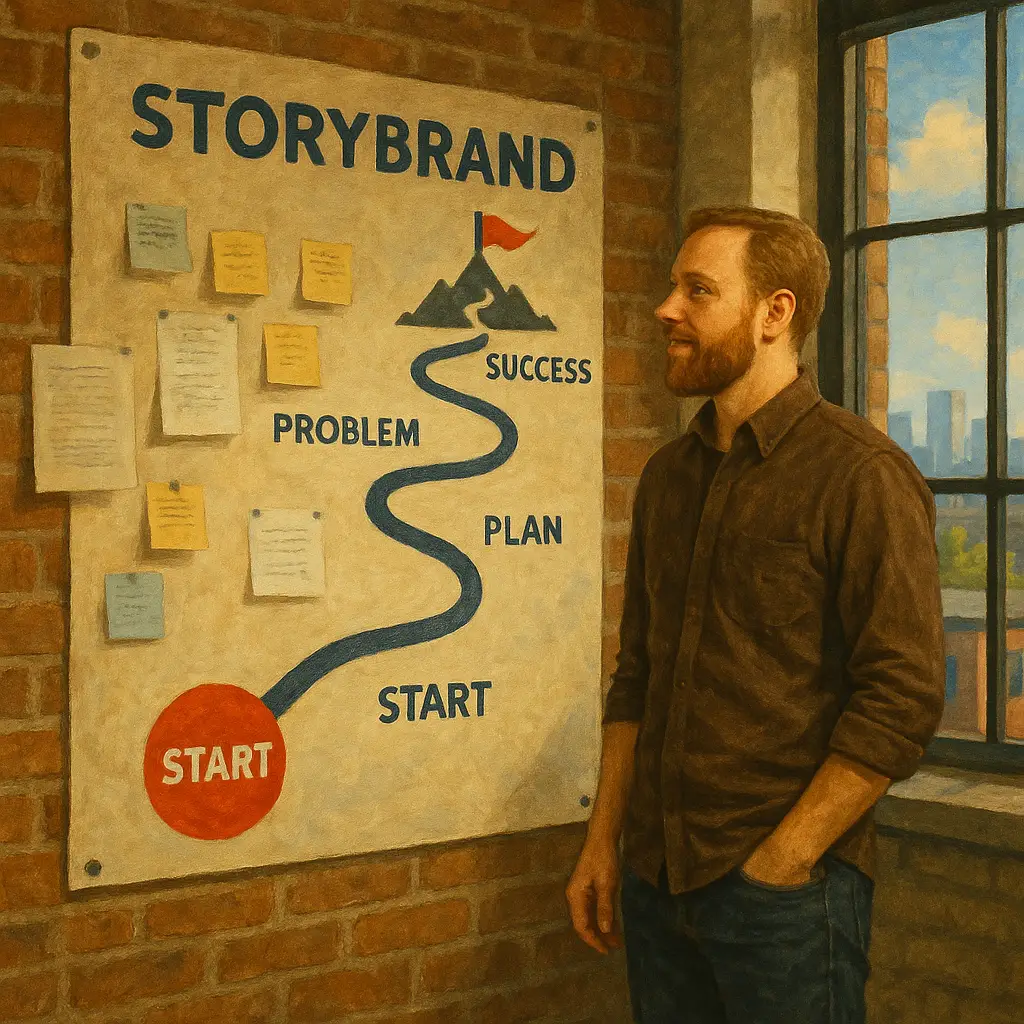
Start with clarity: the StoryBrand approach to energy sector marketing
Before you spend a dollar on ads or write a single blog post, you need a clear message.
StoryBrand is a simple way to get that clarity. It helps you explain complex work in plain language, so busy buyers and stakeholders understand you fast and trust you sooner.
The big idea
A lot of energy marketing fails for one reason: it tries to sound smart instead of trying to be understood.
StoryBrand flips that.
The big idea is:
Your customer is the hero
Your brand is the guide
Clarity beats clever
The StoryBrand seven-part framework, simplified
Here is the simplified seven-part framework you can use in energy sector marketing:
Character: who is the buyer?
Problem: what is making their job hard?
Guide: why should they trust you?
Plan: what process reduces risk?
Call to action: what is the next step?
Success: what good outcome do they want?
Failure: what do they need to avoid?
This is not fluffy storytelling. It is a clarity tool.
How energy companies can use StoryBrand without sounding salesy
Do not translate your work into hype. Translate it into outcomes.
Instead of:
innovative solutions
leading provider
best-in-class service
Use outcomes energy buyers actually care about:
safer operations
higher uptime
fewer unplanned shutdowns
clearer compliance
tighter cost control
better schedule certainty
cleaner handoffs between teams
fewer surprises in the field
Energy sector marketing works when the buyer thinks:
Finally. Someone gets what is at stake here.
BrandScript prompts for energy teams
Run this mini checklist in a one-hour workshop.
Ask:
What do they want, in plain words?
What is making it hard right now?
What is at stake if nothing changes?
Why should they trust us?
What plan do we offer, step by step?
What is the next step we want them to take?
Keep the answers short.
Energy sector marketing strategy: build a system, not random tactics
Random tactics are like wandering off trail because you saw something shiny in the bushes.
A real energy sector marketing strategy is a system. It has structure. It repeats. It compounds.
The three pillars
A simple three-pillar view:
Earned media: SEO, content, authority, and trust you earn over time
Paid media: ads and retargeting that accelerate what is already working
Lead generation: offers and nurture that turn attention into qualified conversations
Your funnel in one page
Attract: helpful content, search visibility, project pages, case studies
Capture: lead magnet, checklist, spec sheet bundle, capability pack
Nurture: email sequence, proof, process, safety, project examples
Convert: meeting, discovery call, site walk, RFQ intake, vendor onboarding
The messaging map
A messaging map keeps your whole team aligned.
One core message gets reused across:
landing pages
content
video
proposals
trade shows
sales outreach
recruiting
Earned media: SEO and content that makes buyers trust you
Earned media is the trust you build before anyone ever talks to sales.
It is what happens when your website, search results, and content keep showing up with clear answers and real proof.
In this section, we will cover how SEO and evergreen content help energy buyers research you, shortlist you, and feel confident reaching out.
SEO for energy companies
SEO is a long-game channel, and that is exactly why it fits energy.
Energy buying cycles are research-heavy. People search, compare, shortlist, and validate before they ever reach out.
Strong energy sector marketing SEO means:
you show up when buyers are researching
you answer questions clearly
you demonstrate proof and process
you build trust before the first call
Content clusters that fit energy search intent
Energy search intent usually falls into a few buckets:
How it works: technical explainers in plain language
Compliance and safety: what standards you follow, how audits work, what your process looks like
Case studies and project pages: what you built, where, for who, what changed
FAQs: objections, risks, timelines, cost drivers
Procurement pages: vendor onboarding, documents, insurance, capabilities, regions served
Evergreen content strategy
Evergreen content is your Built to Last library.
Instead of chasing news and trends, you publish pages that will matter next month, next year, and five years from now.
Examples:
What is a turnaround, and how do you plan one safely?
How vendor onboarding works for energy projects in Canada
How to reduce unplanned downtime with proactive maintenance
What to include in a bid-ready capability statement
Common safety documentation buyers expect before site work begins
Owned media in a regulated landscape
Owned media means channels you control:
your website
your email list
your case study library
your videos you can reuse
your PDFs and capability packs
Owned media keeps you steady.
What to publish
Publish what buyers need to say yes.
Start with:
capability pages (what you do, where, for who)
project spotlights (real work, real photos)
how we work pages
safety culture and QA pages
community investment stories with real specifics
technical explainers written for non-technical stakeholders too
Website and landing pages that convert in the energy sector
Your website is often the first safety check buyers run, even if they never say it out loud.
In a few fast clicks, they are looking for proof, process, and a clear next step. If they cannot find it, they move on.
This section shows you how to build pages that answer the right questions quickly and turn interest into real conversations.
What energy buyers need in thirty seconds
In the first thirty seconds, energy buyers want to know:
What do you do?
Who is it for?
What region do you serve?
What proof do you have?
How do you work?
What is the next step?
The must-have pages
Most Canadian energy companies need:
Services
Industries served
Case studies and project pages
Safety and QA
Certifications and compliance
Team and leadership
Procurement and vendor onboarding
Careers and recruiting
Contact with clear conversion paths
Trust signals that matter
Trust signals in energy are practical:
certifications and training standards
safety stats with context
client logos (with permission)
testimonials that mention outcomes
project photos that look real
measurable results (schedule saved, downtime reduced, incidents reduced, rework avoided)
Conversion paths
Give buyers clear next steps:
Book a call
Request a quote
Vendor onboarding
Download spec sheet
Schedule site walk
Get a capability pack
Ask a technical question
Build trust faster with video and visual storytelling
In energy, trust is not built by saying the right words. It is built by showing the work.
Video and strong visuals let buyers and stakeholders see your people, your process, and your safety culture. It is like letting someone walk the site with you before they ever book a meeting.
In this section, we will cover the video formats that build confidence and move decisions forward.
Why video works in energy
Energy is physical. It happens in real places with real people and real consequences.
Video helps you show:
competence in the field
safety culture in action
scale and complexity
people behind the work
process, not just promises
Video types that support sales and stakeholders
Case study mini-docs (problem, process, result)
Facility tours (equipment, people, safety)
Safety and training videos
Project updates (stakeholder-friendly)
Recruitment stories (culture, pride, expectations)
Audio and podcast strategy
Audio can help you explain complex topics without a wall of text.
It also creates content you can reuse as blogs, clips, and emails.
Paid media: ads that match the energy buying journey
Paid media is like a snowmobile on the right trail. It can help you cover ground faster, but it is not a replacement for a solid route.
In energy sector marketing, ads work best when they support a longer decision process. That means clear offers, strong proof, and landing pages that match the promise.
In this section, we will show you when to use paid media, what to promote, and how to retarget in a way that feels helpful.
When paid media makes sense
Paid media often makes sense for:
recruiting in specific regions
local awareness for community updates
niche services with clear search intent
high-intent searches
event and trade show promotion
What to advertise
Keep it simple: one clear offer per campaign.
Examples:
Discovery call
Website or messaging audit
Bid-ready checklist
Capability pack
RFQ intake form
Spec sheet bundle
Retargeting that feels helpful
Retarget visitors with:
FAQs
case studies
proof and certifications
process pages
a helpful lead magnet
Message match
If your ad promises one thing and your landing page talks about something else, conversions drop.
Match:
the headline
the main promise
the proof
the call to action
Metrics that matter in energy sector marketing
If you do not measure the right things, you will end up hiking in circles.
In energy sector marketing, the goal is not attention. The goal is progress toward real work: meetings, RFQs, vendor approvals, and hires.
This section will help you focus on numbers you can act on, and build a reporting rhythm that supports better decisions.
Avoid vanity metrics
Likes and impressions can be fine signals.
But they are not business outcomes.
KPIs you can actually manage
Track:
lead quality (sales accepted leads)
cost per qualified lead
meetings booked
RFQs received
vendor approvals
sales cycle velocity
branded search growth
conversion rate on key pages
Reporting rhythm
Weekly: leading signals
Monthly: decisions
Quarterly: strategy resets
Offline still works: outbound and field marketing for energy
Digital gets you found, but boots on the ground can still open doors in energy.
When outbound is done with respect and a clear value offer, it helps you reach decision makers faster, especially in tight regions and niche service lines.
In this section, we will cover simple field marketing tactics that connect back to your website, tracking, and follow up so the effort does not get wasted.
Door-to-door prospecting
Done professionally: targeting, timing, value-first messaging.
Cold calling that works
A simple structure:
why you are calling
what you noticed
one proof point
one clear next step
Direct mail for decision-makers
Use:
a short one-page offer
a QR code to a landing page
a trackable call to action
Print that gets results
One-pagers, capability sheets, and trade journal ads tied to tracking.
Events, sponsorships, and trade shows that pay off
Events can feel old school, but in energy they still move the needle.
A good sponsorship or trade show is not just a logo on a banner. It is a chance to build real relationships, earn trust, and get in front of decision makers who rarely fill out a web form.
In this section, we will show you how to treat events like campaigns so you can track results and turn one weekend of effort into months of content and follow up.
Event sponsorship as community investment
Visibility plus trust, when the fit is real.
Trade show ROI
Treat shows like campaigns:
pre-show outreach
booth story
post-show follow-up
Post-event content
Turn one event into weeks of clips, articles, and emails.
Talent and capacity: build an in-house content engine
In energy, the best stories are usually sitting inside your own team.
Your people know the work, the safety standards, and the real details that buyers and stakeholders care about. When you build a simple in-house content engine, you can move faster, stay accurate, and earn trust without relying on last-minute scrambling.
In this section, we will cover the lean roles and repeatable habits that make in-house content realistic.
Why in-house content matters in energy
In-house content helps because:
it is authentic
it is faster to approve
it is more technically accurate
it reduces risk
What roles you actually need
Subject expert
Coordinator
Writer
Video partner
Reviewer
Training your team to tell the story
Use:
simple templates
interview prompts
content calendar
approvals workflow
Common mistakes in energy sector marketing
Even strong teams can get turned around if the basics slip.
Most marketing problems in energy are not about effort. They come from unclear messaging, weak proof, or missing next steps.
In this section, we will call out the most common mistakes so you can avoid them and stay on a clear path.
Leading with jargon and acronyms
Start with the outcome. Then explain the technical side.
Inconsistent message across channels
One map. One route. One story.
Talking about yourself instead of the buyer’s problem
Make the buyer the hero.
Making big ESG claims without proof
Keep claims specific, supportable, and documented.
Publishing content with no conversion path
Always include a next step.
When to bring in a professional energy marketing partner
At some point, most energy teams hit the same wall.
You know marketing matters, but the message feels messy, the content is inconsistent, and leads are not turning into the right conversations.
A good partner helps you stop guessing and start running a clear system, with proof, tracking, and an approvals process that fits the energy world.
Signs you need help
content stalls
message is inconsistent
ads do not create qualified leads
website does not convert
reporting is unclear
What a good partner should deliver
messaging system
clear plan
measurable outcomes
brand consistency
stakeholder sensitivity
approvals workflow
What to ask before you hire
examples
process
proof
reporting
compliance awareness
Your next steps for energy sector marketing
A good plan should feel like a clear route, not a giant to do list.
These next steps are meant to help you build momentum fast, then stack wins that last. Start small, measure what matters, and keep moving forward.
A simple one-month plan
Clarify message
Fix key pages
Publish two authority pieces
Launch one lead magnet
Start nurture
A simple three-month plan
Build one content cluster
Publish one strong case study
Add retargeting
Improve lead quality
Align KPIs
Need help choosing your next step? Get in touch with the marketing outfitters at EV Agency. We’ll help you chart the path—and walk it with you.
FAQs: Energy Sector Marketing
Energy sector marketing is how an energy company explains what it does, proves it is credible, and builds trust so it wins work, approvals, and talent.
It has more audiences, longer sales cycles, higher-risk decisions, and more scrutiny.
A strong website, SEO and evergreen content, case studies, video, email nurture, paid search, and targeted outreach.
Services, proof, safety and QA, certifications, procurement info, and a clear next step.
Yes. It matches research-heavy buying cycles and builds trust before the first call.
Both need clarity, proof, and process. The emphasis shifts based on stakeholder concerns.
Use specific, supportable claims with documentation and clear boundaries.
Cost per qualified lead, meetings booked, RFQs received, vendor approvals, and sales cycle velocity.
A hybrid model usually works best: in-house expertise plus external production and strategy support.
Want the full playbook?
Read our online Energy Marketing Guide for more practical examples, templates, and step by step systems you can use right away.
Join us in celebrating the 100th anniversary of the Dawson Creek Exhibition & Stampede. Discover highlights from this year’s rodeo and chuckwagon races.
Discover the basics of content and inbound marketing in our guide for industrial, construction, and corporate leaders. Learn how to create meaningful connections with your audience.

Discover the benefits of partnering with EV Agency, your single marketing agency, to elevate your brand and ensure success. Learn about our comprehensive marketing services and success stories.
Discover how inbound marketing acts as your brand’s campfire, drawing in the right audience with valuable content and creating lasting connections that drive business growth.

Discover how video production enhances corporate marketing strategies. Learn how videos boost engagement, brand awareness, and ROI for your business.

Discover the top 10 marketing strategies for small businesses in Edmonton. Learn how local SEO, social media, and community engagement can boost your brand.

Discover the pros and cons of in-house vs. outsourced social media management. Explore which option is best for your business with insights from EV Agency.

Discover why video marketing should be your top priority in 2025. Learn how video content boosts brand engagement, increases conversions, and enhances business growth. Partner with EV Agency to ignite your brand’s video marketing strategy.

Discover how to choose the best video production company in Vancouver. Learn what factors to consider for effective video marketing.

Discover how an SMMA can help small businesses compete with larger brands on social media through targeted ads, creative content, and expert strategies.