Some websites do not break because they look old. They break because they can no longer carry the weight of the content inside them.
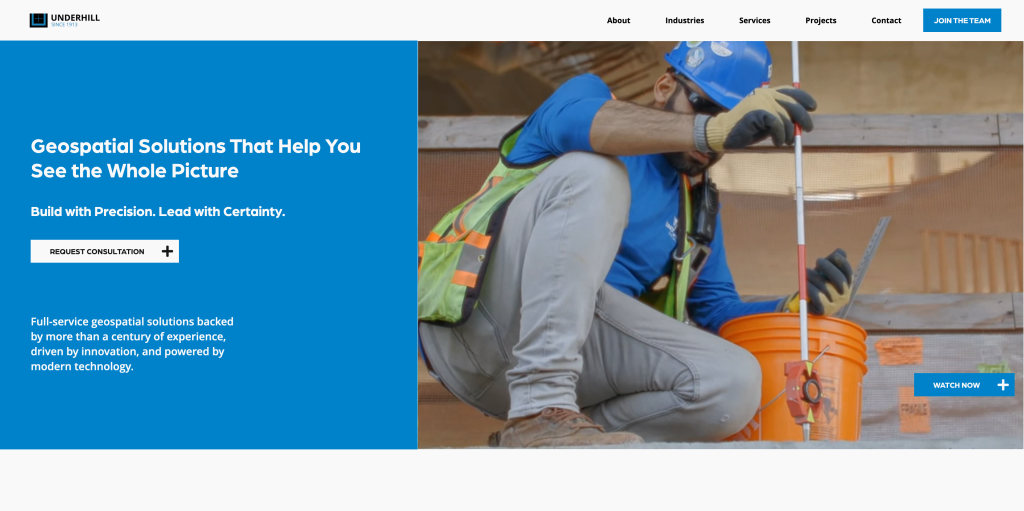
That was the challenge with Underhill Geomatics Ltd. With nearly 100 years of history and hundreds of pages of portfolio content, the website needed more than a visual refresh. It needed a stronger system.
The goal was to create a site that could organize a large and growing body of work in a way that stayed clear, connected, and easy to explore.
Our role was to lead the rebuild and create the content structure that would make that possible. At the heart of the project was a custom portfolio taxonomy designed to organize projects by service, sector, office, technology, and project type. That structure turned a large archive into a more useful, more searchable, and more scalable website.


TL;DR
- We led the website rebuild for Underhill Geomatics Ltd., a company with nearly 100 years of history and a large portfolio of project content.
- The key to the project was a custom portfolio taxonomy that organized projects by type, office, services, technology, and sector.
- We built dynamic content pathways so related projects could connect automatically across the site.
- The new structure made it easier for visitors to explore the portfolio and easier for staff to manage future growth.
- This project showed how strong content architecture can help a large website grow without becoming messy.
The Trailhead
Underhill Geomatics Ltd. had a scale problem, but it was the kind that comes from a long and successful history.
With nearly a century of work behind them, the company had built up a large portfolio spanning many project types, industries, offices, and technical services. That depth was valuable, but it also created a challenge. As the content library grew, the website needed a better way to organize it so people could actually explore it without getting lost.
This was not just about having hundreds of pages. It was about making those pages work together. Visitors needed a way to move through the portfolio by interest, location, service, and sector. Staff needed a structure that would support growth over time without forcing them to manually rebuild the site every time new content was added.
That gave the project a clear direction from the start. The website needed a stronger foundation, not just a cleaner surface.
What the Client Needed
Underhill needed a website that could grow with the business and still stay easy to manage.
That meant more than updating design or improving page layouts. The real need was structural. The company had a large body of portfolio content that needed to be organized in a way that felt clear to visitors and practical for internal teams.
The portfolio could not just be a long list of projects. It needed to become a connected system. A visitor should be able to browse projects by type, such as construction or infrastructure, then continue exploring by office, by service, by technology, or by sector. That kind of navigation helps people understand not only individual projects, but also the broader scope of what the company does.
Success looked like a website that could support a large content library without becoming cluttered, confusing, or difficult to maintain. It needed to help people discover more of the company’s work while making future updates easier for staff.
In the end, the need was simple to describe but important to build well. Underhill needed a website that could hold a lot of history without feeling heavy.
The Plan We Mapped Out
When content is large and layered, structure has to come before polish.
We began by looking at the scale of the portfolio and identifying the main content relationships that needed to be reflected on the site. Projects were not isolated pieces. They connected to offices, services, industries, technologies, and categories of work. The site structure needed to reflect that reality.
From there, we built a custom taxonomy system for the portfolio. This became the backbone of the rebuild. Instead of treating every project as a standalone entry, we created a framework where each project could be categorized and connected through shared terms and content rules.
Once that structure was in place, we created dynamic pathways through the content. That allowed visitors to view related projects by office, by service, by sector, or by project type without staff needing to build and update those pages manually one by one.
The goal was to create order without making the site feel rigid. We wanted the portfolio to feel rich and expansive, while still giving people clear ways to explore it.
Throughout the rebuild, the focus stayed on long-term usability. This was not just about making the current site better. It was about making future growth easier to handle.
What We Delivered
The project centred on a full website rebuild designed to support a large and complex body of content.
At the heart of that rebuild was a custom portfolio taxonomy system. This allowed Underhill’s project library to be organized and interconnected by project type, office, services used, technology deployed, and industry sector served.
That structure made the portfolio far more useful. Visitors could move through the content based on what mattered to them, and related projects could surface automatically through shared categories and tags.
We also built hub pages and dynamic loops tied directly to the taxonomy system. That meant the site could automatically display relevant projects by office, service, or sector without relying on staff to manually create new collections every time content was added.
Beyond the portfolio structure itself, the rebuild supported a cleaner and more scalable website experience overall. It gave the company a stronger foundation for managing a large historical archive while continuing to add new content over time.
Taken together, the deliverables did more than improve navigation. They gave Underhill a content system designed for long-term clarity.
How We Built the Site (On-the-Ground Approach)
Large websites need more than good design. They need rules that make growth manageable.
That shaped the way we approached this project. Rather than starting with appearance alone, we focused first on content architecture. The most important question was not what the site should look like. It was how the site should think.
The answer was to build a portfolio system that mirrored how the company’s work is actually understood in the real world. Projects are shaped by service lines, by office locations, by sectors served, and by technical methods. Once those relationships were reflected in the site structure, the rest of the experience became much easier to build around them.
This approach also reduced the long-term maintenance burden. Staff do not need to manually recreate the same connections across dozens of pages. Once the right categories and tags are assigned, the content can appear in the right hubs and related sections automatically.
That kind of structure creates two kinds of value at once. It improves the visitor experience, and it makes the site easier to manage behind the scenes.
In the end, the site became more than a digital brochure. It became a system for organizing and surfacing a very large body of work with much more clarity.
The Results (Proof You Can Feel)
No public performance metrics were provided for this project, so we are not going to invent outcomes that were not shared.
What is clear is that the rebuild gave Underhill a stronger way to manage and present a very large portfolio.
Instead of treating hundreds of pages as separate pieces, the new site connects them through a structured taxonomy that helps visitors move through the content more naturally. That makes the portfolio easier to explore and helps the company’s depth of experience become more visible.
The project also improved long-term usability for staff. Because the site uses dynamic loops and taxonomy-based content relationships, updates become more efficient and the risk of content disorder drops over time.
There is also a broader strategic result here. A company with nearly 100 years of project history needs a website that can tell a bigger story than any single page can hold. This rebuild created the framework for that story to unfold more clearly.
In practical terms, that is what changed. The website became easier to navigate, easier to manage, and better equipped for future growth.
A Few Lessons From This Project
This project reinforced a few important lessons about large-content websites.
First, structure needs to come early. Once a content library grows large, it becomes much harder to impose order later. Strong taxonomy planning at the beginning saves time and confusion down the road.
Second, connected content is more useful than isolated content. When projects relate to services, sectors, offices, and technologies, the website should help people follow those connections naturally.
Third, dynamic systems scale better than manual ones. Hub pages and automated content loops make it possible for the site to keep growing without staff needing to rebuild the same pathways over and over.
Fourth, taxonomy is not just a technical decision. It affects storytelling too. Good structure helps users understand the bigger picture of what a company does and where its experience runs deepest.
And finally, long history needs careful organization. A company with nearly 100 years of work should feel established, not overwhelming. The right content system helps create that balance.
Why This Matters Beyond One Website
This project is a strong example of what happens when content structure is treated as a strategic tool rather than an afterthought.
For organizations with growing libraries of projects, updates, partners, and history, the real risk is not just clutter. It is losing clarity as the site expands. Underhill had that challenge at a large scale, and solving it required more than attractive design. It required a system.
That lesson carries into any website expected to grow over time. When content types and taxonomies are planned properly, the website becomes easier to use, easier to maintain, and much better at telling the bigger story behind the work.
Ready to Build Something Like This?
If your website needs to grow without becoming harder to manage, the answer is not more pages alone. It is better structure.
Eagle Vision Agency builds websites that help organizations organize complex content with clarity, flexibility, and room to scale. Whether you need a stronger portfolio system, better content architecture, or a full website rebuild, we can help shape the foundation before the mess starts.
Reach out to book a call, request a quote, or start the conversation.